
The ROG Xbox Ally X20 reaches store shelves on October 15, and with eleven days to go the useful question for anyone holding a pre-order, or still weighing one, is not whether it is the most capable Xbox-branded handheld on paper, which it clearly is. The real question is what the $1,299.99 sticker buys over the $999.99 ROG Xbox Ally X that sits right beside it on the ASUS Store, because the two machines share far more than the anniversary styling suggests.
To answer it, we lined up ASUS’s own U.S. spec sheets for the X20 (model RC74XA), the Ally X (RC73XA) and the base Ally (RC73YA), the ASUS pre-order announcement from August 25, Xbox Wire’s pre-order post, and the prices Valve and Nintendo have published for the nearest alternatives. NextGenConsole has not used an X20, and launch reviews are not out yet, so this is a spec-and-price guide built from public listings rather than a verdict on how it plays.
Same chip, same memory, same battery
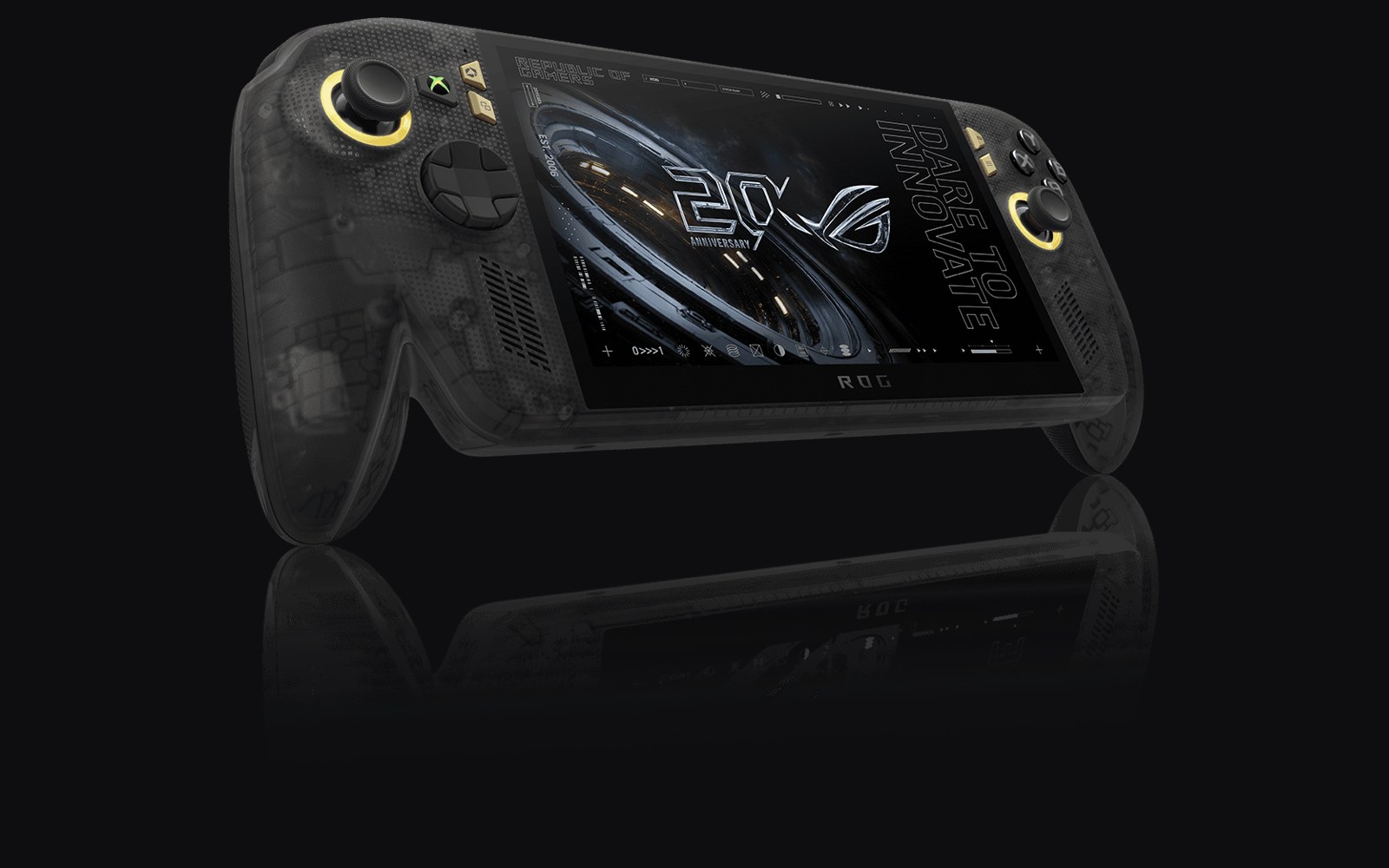
The most important fact is what did not change: the X20 and the Ally X use the same processor, memory, storage and battery. According to ASUS’s X20 spec page and the matching Ally X listing, both machines run AMD’s Ryzen AI Z2 Extreme with eight cores, sixteen threads, boost clocks up to 5.0GHz and an XDNA NPU rated at up to 50 TOPS. Both carry 24GB of LPDDR5X, both ship with a 1TB PCIe 4.0 M.2 2280 SSD, and both use the same 80Wh four-cell battery. Wi-Fi 6E, Bluetooth 5.4, Windows 11 Home and the two-month Xbox Game Pass Premium offer are identical as well. Windows Central, which went through ASUS’s briefing material, reached the same conclusion and pointed out that there is no newer AMD handheld chip on the market to put inside it.
That caps what the extra money can do for frame rates. ASUS says the X20 uses a redesigned PCB with the motherboard shifted to open up airflow, plus revised fan and heatsink fins, and that could help with sustained clocks or fan noise. Nobody has published independent thermal or performance testing yet, though, so until reviews arrive the sensible assumption is that games will run in the same performance class on both devices.
| Spec | ROG Xbox Ally X20 | ROG Xbox Ally X | ROG Xbox Ally |
|---|---|---|---|
| U.S. price (ASUS Store) | $1,299.99 | $999.99 | $599.99 |
| Processor | Ryzen AI Z2 Extreme (8C/16T) | Ryzen AI Z2 Extreme (8C/16T) | Ryzen Z2 A (4C/8T) |
| Memory | 24GB LPDDR5X | 24GB LPDDR5X | 16GB LPDDR5 (6400MT/s) |
| Storage | 1TB PCIe 4.0 M.2 2280 | 1TB PCIe 4.0 M.2 2280 | 512GB PCIe 4.0 M.2 2280 |
| Display | 7.4-inch 1080p 120Hz OLED, 100% DCI-P3, Dolby Vision, FreeSync Premium Pro | 7-inch 1080p 120Hz IPS-level, 500 nits, FreeSync Premium | 7-inch 1080p 120Hz IPS-level, 500 nits, FreeSync Premium |
| Card reader | microSD Express (PCIe Gen4 x1), UHS-I DDR200 | UHS-II microSD | UHS-II microSD |
| USB-C | USB4 (Thunderbolt 4, DisplayPort 2.1) + USB 3.2 Gen 2 | USB4 (Thunderbolt 4, DisplayPort 1.4) + USB 3.2 Gen 2 | 2x USB 3.2 Gen 2 |
| Triggers, sticks, D-pad | Impulse triggers plus Hall effect, TMR sticks, Transforming D-pad | Hall effect triggers, standard sticks and D-pad | Hall effect triggers, standard sticks and D-pad |
| Battery | 80Wh | 80Wh | 60Wh |
| Weight | 756g | 715g | 670g |
| Width | 30.0cm | 29.0cm | 29.0cm |
Where the extra $300 actually goes
Once the shared silicon is set aside, the premium comes down to three areas. The biggest is the screen. The X20 moves from the Ally X’s 7-inch IPS-level panel to a 7.4-inch OLED that ASUS rates at 100 percent of DCI-P3, with Dolby Vision and FreeSync Premium Pro support. Windows Central reports ASUS’s brightness figures as 600 nits in SDR and up to 1,400 nits peak in HDR, compared with the 500 nits ASUS lists for the Ally X. Resolution and refresh rate stay at 1080p and 120Hz, so the gain is contrast, color and HDR rather than sharper output.
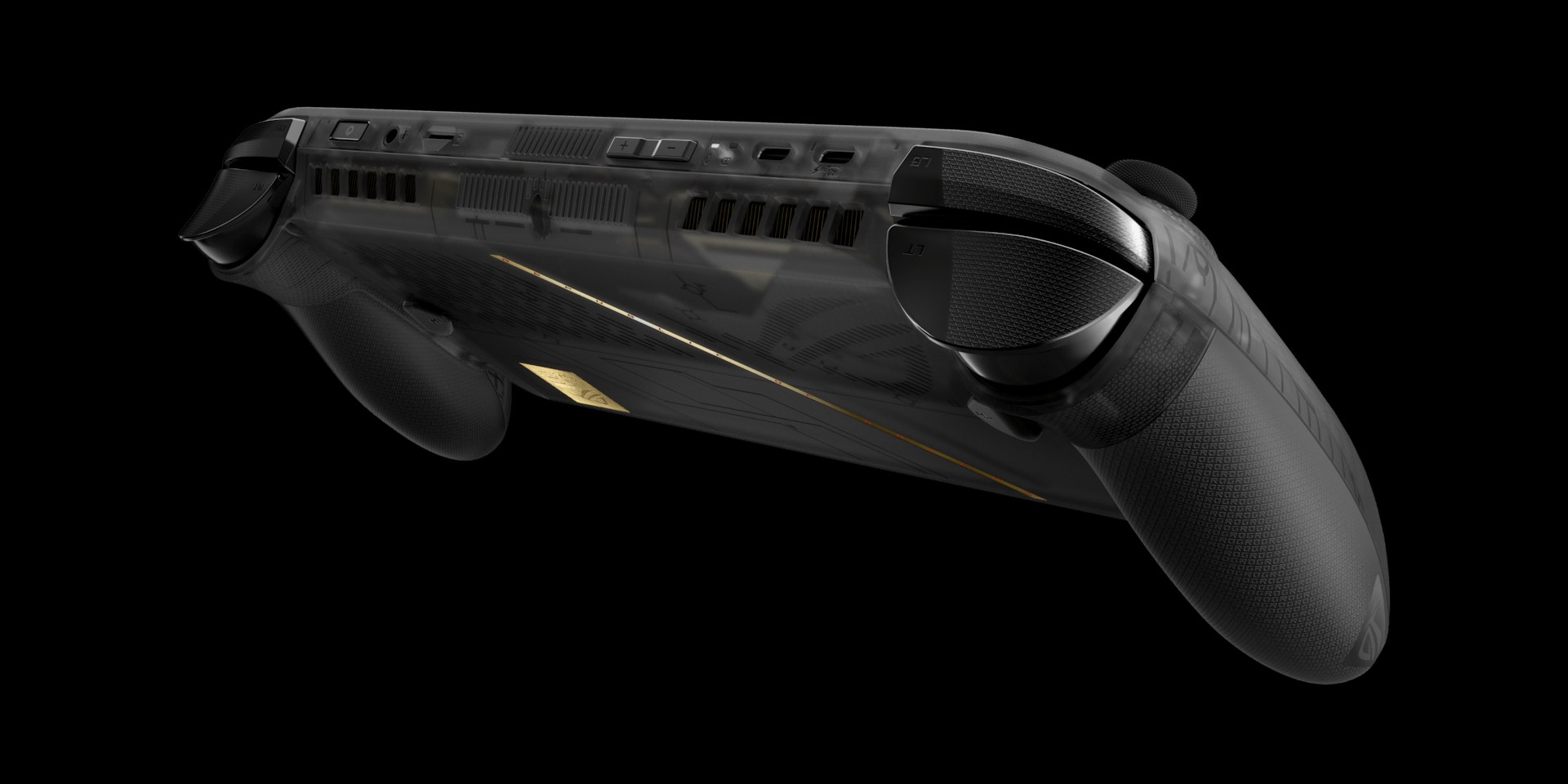
The second area is controls. ASUS’s spec sheet adds impulse triggers, the rumble-in-the-trigger feature Xbox controllers have offered since the Xbox One, alongside TMR magnetic sticks and what ASUS calls a Transforming D-pad that can be rotated to line up diagonals for fighting games. Windows Central reports a dead zone of roughly 3 percent for the new sticks. The third is I/O, where the USB4 port steps up from DisplayPort 1.4 to 2.1 for external displays and the card slot switches to microSD Express.
That card change carries a practical catch the marketing does not spell out. ASUS lists the X20’s reader as supporting microSD Express and UHS-I with DDR200 mode, with no mention of UHS-II. If you are moving over from an Ally X with a fast UHS-II card, the spec sheet suggests it would fall back to UHS-I speeds in the X20, so budget for a microSD Express card if you intend to play from removable storage. The consolation is that it is the same card standard Nintendo requires for Switch 2 game storage. The X20 is also 41g heavier and a centimeter wider than the Ally X, and while the spec page lists a 68W adapter, ASUS notes that charger inclusion varies by country, region and model, so check the box contents at your retailer before you assume one is included.
The upgrade math against the alternatives
The price ladder shows how much the handheld market moved this year. When the Ally and Ally X launched on October 16, 2025, Valve’s Steam Deck OLED sat at $549 and $649 and made Windows handhelds look expensive. Valve’s May 27 increase to $789 and $949, which it attributed to rising memory and storage costs according to Tom’s Hardware, left the 1TB Deck just $50.99 below the Ally X. It is the same memory squeeze we tracked in our October 3 console price guide, and by that list the X20 standalone now costs $400 more than a PS5 Pro at its $899.99 U.S. price.
| Handheld | U.S. price | Gap to X20 | Key difference |
|---|---|---|---|
| ROG Xbox Ally X20 | $1,299.99 | Baseline | OLED, new controls, same Z2 Extreme as Ally X |
| ROG Xbox Ally X | $999.99 | −$300 (X20 is 30% more) | Same chip, RAM, SSD and battery; IPS screen |
| ROG Xbox Ally | $599.99 | −$700 | Ryzen Z2 A, 16GB, 512GB, 60Wh |
| Steam Deck OLED 1TB | $949 | −$350.99 | 7.4-inch 1280×800 OLED, SteamOS |
| Steam Deck OLED 512GB | $789 | −$510.99 | Same Deck, half the storage |
| Nintendo Switch 2 | $499.99 | −$800 | Different library, Nintendo first-party games |
| ROG Xbox Ally X20 Bundle | $2,499.99 | +$1,200 | Adds ROG XREAL R1 Edition 20 glasses, dbrand Killswitch, Pelican case, 68W adapter |
The bundle deserves its own note. ASUS says the Edition 20 glasses will also be sold separately, but its announcement did not list a standalone price. Windows Central puts the regular ROG XREAL R1 glasses with their dock at $849.99, which suggests most of the $1,200 bundle premium is the glasses rather than the case and skin. The two months of Game Pass Premium, worth $29.98 at the $14.99 U.S. monthly price we noted in our Game Pass October guide, come with all three Ally models, so they do not change the gap between them.
How we got here
| Date | What happened |
|---|---|
| Oct 16, 2025 | ROG Xbox Ally ($599.99) and Ally X ($999.99) launch |
| May 27, 2026 | Valve raises Steam Deck OLED to $789 (512GB) and $949 (1TB), citing memory and storage costs |
| Aug 25, 2026 | ASUS and Xbox Wire open X20 pre-orders: $1,299.99 standalone, $2,499.99 bundle; Best Buy first |
| Sept 1, 2026 | Switch 2 U.S. MSRP rises from $449.99 to $499.99 |
| Sept 24, 2026 | ASUS Store pre-orders open, per Windows Central |
| Oct 15, 2026 | X20 and the X20 Bundle on shelves |
ASUS’s official trailer gives a decent look at the translucent shell and the new controls, which are the parts of the X20 that differ most from the Ally X.
Who should buy which
| If you… | Practical call | Why |
|---|---|---|
| Already own an Ally X | Skip unless the OLED matters most to you | Same chip, memory, storage and battery; the money buys screen, controls and I/O |
| Own the base Ally | Ally X is the value step, X20 if you want OLED | Both move to Z2 Extreme and 24GB; the X20 adds $300 on top for the screen and controls |
| Pre-ordered the X20 for HDR or fighting games | Keep it, but read launch reviews before your return window closes | Dolby Vision OLED, the Transforming D-pad and impulse triggers are the X20’s unique features |
| Mostly play your Steam library on a Deck | Weigh the $350.99 gap carefully | The 1TB Deck is $949; the X20 adds a 1080p OLED, Windows and the Xbox PC app |
| Want a handheld for Nintendo games | Switch 2 | Different library, and $800 cheaper than the X20 |
| Considering the $2,499.99 bundle | Only if you want the AR glasses | It costs $1,200 more than the standalone X20, mostly for the glasses |
Put simply, the X20 is the Ally X with a much better screen, Xbox-style triggers and fighting-game-friendly controls, not a faster handheld. For players who spend hours in HDR games or care about D-pad feel, that may well be worth $300. For everyone else, the Ally X at $999.99 delivers the same Z2 Extreme performance class today, and the sensible move is to wait for the first independent reviews around launch to see whether ASUS’s cooling changes make a measurable difference.